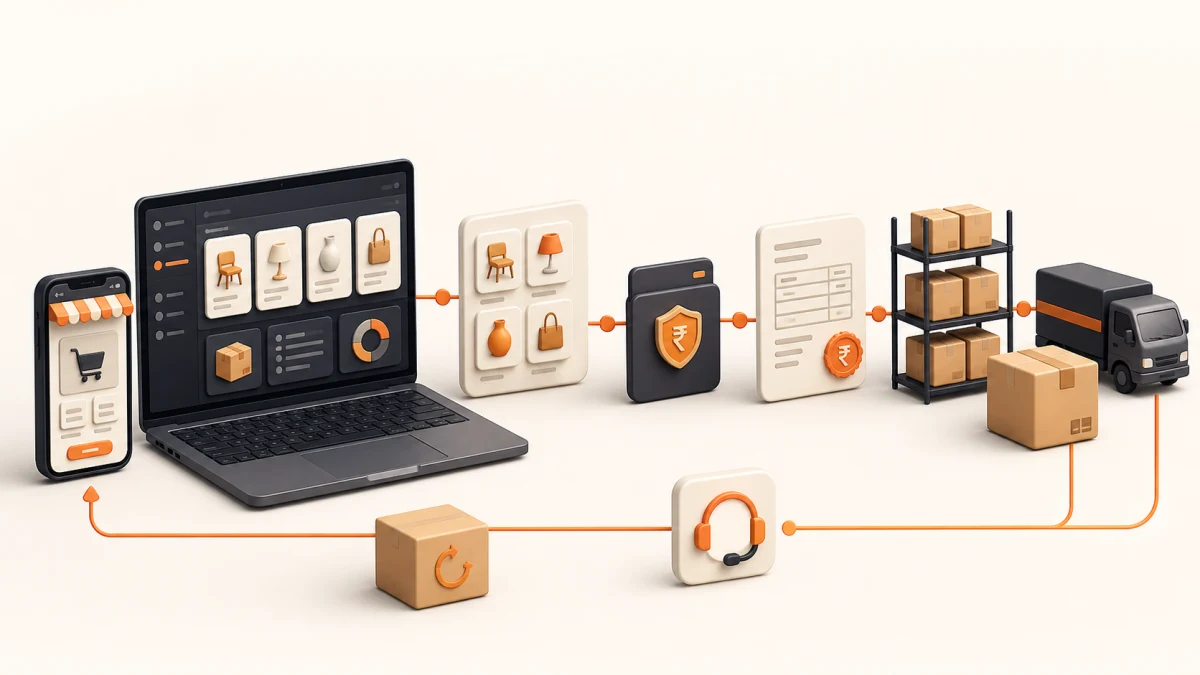
An eCommerce operations checklist India businesses can use should connect catalogue data, checkout, UPI-ready payments, GST handoff, inventory, delivery, returns, support, security and reporting. Choose Shopify, WooCommerce or custom only after these operating requirements, owners and failure paths are clear.
Planning a project? Explore our eCommerce development service →
eCommerce operations checklist India businesses can run
A storefront is only the visible edge of an online retail operation. Behind each product page sits catalogue ownership, stock accuracy, payment confirmation, invoice data, picking, dispatch, delivery exceptions, returns and customer communication. If these handoffs are undefined, a polished checkout can create more manual work rather than less. Begin by drawing one order from product discovery to settlement and final resolution.
For every step, record the system of record, responsible person, required data, acceptable response time and exception path. A successful payment with no order confirmation needs an owner. So does an item that sells online after physical stock has run out, an address that a courier rejects, a partial dispatch, a customer-requested cancellation and a refund that appears in one system but not another. The design brief should include these states before anyone chooses a theme.
Separate launch requirements from later improvements. Version one may need a controlled catalogue, dependable checkout, one verified payment gateway, defined tax-data handoff, sensible delivery rules, returns handling, analytics and support access. Loyalty, subscriptions, multi-warehouse routing or marketplace synchronisation can follow when the business has evidence and an owner for the extra complexity.
Make catalogue and inventory data operational
Catalogue quality is operational data, not just marketing copy. Define the product identifier, title, variant structure, price, tax category supplied by the business, dimensions, weight, stock status, images, fulfilment location and return eligibility for every item type. Decide who can create or change this information, how changes are approved and whether a spreadsheet, ERP, point-of-sale system or store admin is authoritative.
Inventory rules need to match the real business. Set behaviour for low stock, back-orders, damaged stock, bundles, physical-store sales and cancelled orders. Test whether stock is reserved at cart, order or payment confirmation, and what releases that reservation. When multiple systems can change quantity, document synchronisation timing and failure alerts; a silent integration failure can keep accepting orders even though each screen looked correct during launch testing.
Design UPI, payment and GST-data handoffs together
NPCI describes UPI as supporting merchant payments and documents QR, intent, application-based and collect integration modes. An online store normally reaches these capabilities through an acquiring bank or payment provider, so verify merchant eligibility, supported checkout flows, settlement reports, refund behaviour, webhooks and sandbox testing with the selected provider. Do not assume a UPI badge means every operational state is already handled.
Model payment states explicitly: initiated, pending, successful, failed, abandoned, reversed, partially refunded and fully refunded. The order system should respond safely when a callback is delayed or repeated, and staff should be able to reconcile store orders with gateway settlements. Customers need clear confirmation without exposing sensitive payment data. Access to refunds and gateway credentials should follow least privilege, multi-factor authentication and a documented approval route.
Treat GST as a governed data workflow, not a generic plugin switch. The business and its tax adviser should define registration details, place-of-supply inputs, product tax treatment, invoice fields, credit-note handling and any e-invoicing or marketplace obligations that actually apply. The official GST glossary explains e-invoicing as reporting specified GST documents to a notified portal to obtain an Invoice Reference Number; it does not mean every PDF generated by a shop is automatically compliant. Build the data export and integration around verified advice, then test representative B2C, B2B, cancellation and refund cases.
Connect delivery, returns and support before launch
A delivery integration needs more than a shipping-rate widget. Define serviceable postcodes, origin locations, packaging, weight and dimension rules, handling time, courier selection, label creation, tracking updates, failed delivery, return-to-origin and proof of delivery. Shopify documents flat, free and carrier-calculated approaches, but the right rule depends on margin, destination, product characteristics and the providers available to the merchant.
Write the returns flow as carefully as checkout. State which products are eligible, how the request is approved, who arranges pickup, when stock returns to saleable inventory and when the refund begins. WooCommerce, for example, distinguishes automatic and manual refunds; a manual record in the store does not itself move money through the gateway. Whatever the platform, staff need one view of the commercial and operational status.
Customer communication should follow real events. Map order confirmation, payment failure, dispatch, tracking, delay, delivery, cancellation, return and refund messages, then test email, SMS or WhatsApp only where consent and channel rules permit. Give support staff order context without sharing full administrative access, and establish an escalation path for payment or delivery disputes that cannot be solved from the store dashboard.
Choose Shopify, WooCommerce or custom by ownership
Platform choice is an ownership decision. Shopify can reduce infrastructure and core-platform administration for a team that wants a managed service, but India is not currently listed among Shopify Payments-supported countries, so an Indian merchant must verify a compatible third-party payment provider and its commercial terms. WooCommerce offers deeper WordPress-level control and a broad extension model, while making hosting, updates, compatibility, security and recovery discipline explicit responsibilities.
A custom commerce system is justified when a validated operating model cannot be supported responsibly through a managed platform, standard extensions or clean integrations. Custom code adds product ownership, testing, security, observability and maintenance duties. Compare the full operating fit and total responsibility over several years, not only the initial build quote or the number of features in a sales demonstration.
| Decision factor | Shopify | WooCommerce | Custom |
|---|---|---|---|
| Best starting fit | Managed commerce with standard workflows | Content-led stores needing flexible ownership | Validated specialist operations |
| Payments in India | Verify an eligible third-party provider | Select and maintain a compatible gateway extension | Build against verified provider APIs and controls |
| Operating ownership | Configuration, apps, catalogue and process | Hosting, WordPress, extensions and process | Architecture, code, infrastructure and process |
| Change risk | App and plan constraints | Plugin compatibility and maintenance | Engineering capacity and regression risk |
| Decision test | Do standard workflows fit the team? | Can the team own WordPress operations? | Is the unique workflow valuable enough to own? |
Launch with a tested runbook and measurable ownership
Before launch, run end-to-end tests with representative products, variants, addresses, tax-data cases, payment outcomes, coupons, stock limits, cancellations, partial and full refunds, shipment exceptions and support permissions. Test mobile devices and slower connections. Confirm backups, restore steps, uptime monitoring, error logging, gateway alerts, domain and certificate ownership, administrative multi-factor authentication and a maintenance calendar.
Create a launch runbook naming the decision maker, store administrator, fulfilment owner, finance reconciler, tax adviser, customer-support lead, developer and incident contact. Include where credentials are held, who can approve refunds, how a bad release is rolled back, which integrations can be paused and how orders are handled during downtime. The runbook turns platform capability into accountable business operation.
Measure completed orders, payment failures, fulfilment time, cancellations, returns, support reasons and reconciliation differences without inventing universal benchmarks. Review recurring exceptions weekly after launch and fix the underlying data, process or integration before buying another feature. Bring the current catalogue, payment plan, GST workflow, delivery rules and integration map to a free growth audit so the roadmap reflects the business you actually operate.
A reliable online store begins with operating decisions that can be tested before launch. Our free growth audit maps the catalogue, payments, tax-data handoff, fulfilment, integrations and ownership gaps that should shape your practical eCommerce roadmap.
Map your eCommerce operations before you build →