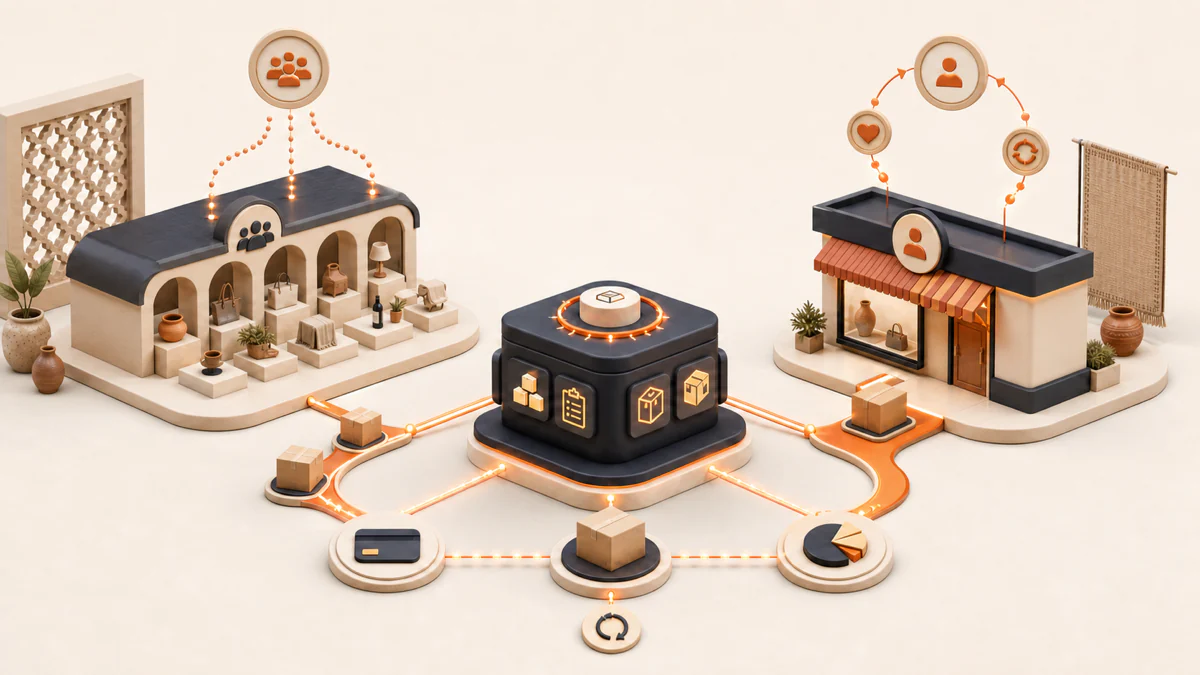
Amazon vs own website is not a winner-takes-all choice. Amazon can accelerate discovery and operational reach; an owned store gives control over margins, customer experience and repeat demand. Compare contribution per delivered order, cash timing and channel dependence before investing.
Planning a project? Explore our eCommerce development service →
Amazon vs own website starts with contribution
Gross sales are a poor channel score because neither a marketplace payout nor a website checkout is profit. Start with delivered-order contribution: selling price minus product cost, channel charges, fulfilment, discounts, acquisition, return allowance and the share of fixed operating cost required to serve that order. Use the same tax treatment and product cost on both sides.
Amazon publishes a shorter profitability formula: selling price minus referral, closing, weight-handling, other applicable fees and product cost. That is a useful base, but a seller’s decision sheet should also include advertising, packaging, inbound movement, return losses, account-management time and cash held until settlement. Costs that do not appear on the fee invoice can still remove margin.
For an owned store, include the payment gateway, platform or hosting, development amortisation, apps, courier, support, content, performance marketing and returns. Then calculate first-order and repeat-order contribution separately. This is the central marketplace vs own store question: which channel creates profitable delivered customers, not which dashboard reports more orders.
Marketplace reach changes the cost equation
Amazon can place an unfamiliar product in front of shoppers who already trust the marketplace, compare alternatives and expect delivery support. Fulfilment by Amazon can store, pack, ship and handle customer service and returns for eligible inventory, while Prime eligibility can improve the offer’s delivery promise. Those capabilities can replace work a small team would otherwise build.
The fee headline is not the complete bill. Amazon’s current public page says referral fees start at zero and vary by category, while closing fees vary by price and fulfilment channel and weight-handling fees vary by size and distance. Amazon also promotes zero referral fees for many products priced at or below ₹1,000, but closing, shipping and optional programme charges can still apply.
Pull the actual ASIN-level estimate for every important SKU and fulfilment route; do not paste one category’s percentage across the catalogue. Record the expected payout date as well. Amazon says eligible sellers are paid seven days after delivery, including Pay on Delivery orders, so cash planning must begin at delivery rather than the order date.
Owned-store economics improve with repeat demand
An owned website gives the business control over product presentation, bundles, editorial content, checkout priorities, consented customer communication and the post-purchase journey. It also removes direct comparison beside competing offers. That control is valuable only when the brand can create qualified visits and reliably operate payments, delivery and support.
Razorpay’s public standard pricing is 2% plus GST per successful transaction, with no standard setup fee or annual maintenance charge. That is one visible line, not the total own-store cost. Allocate monthly platform, maintenance, content and support costs across delivered orders, then add the real acquisition cost for the campaign or source that produced each buyer.
The economic advantage often appears on a genuine repeat order because the website may not need to buy the same customer again. Measure this with consented first-party data and useful retention—not indiscriminate messaging. A weak product or poor experience does not become profitable merely because the seller owns the domain.
Amazon vs own website contribution example
The table below is an illustrative model for one ₹1,500 delivered order, not a quote or a universal benchmark. The marketplace charge is deliberately entered as a replaceable 15% blended assumption. A real seller must substitute the current category, price, dimensions, distance, fulfilment and programme charges shown in Seller Central.
The own-site platform allocation assumes ₹15,000 of monthly technology and support spread across 100 delivered orders. Its gateway line rounds 2% plus GST on the fee. Acquisition and return allowances are planning inputs, not industry averages; replace them with attributed advertising data, courier reports and refund records.
Under these assumptions, the marketplace wins the first order by ₹45, while the owned store wins the repeat order by ₹175. That is why “sell on Amazon or website” cannot be decided from commission alone: acquisition, repeat behaviour and fixed-cost utilisation can reverse the result.
| Per delivered order | Marketplace | Own-site first order | Own-site repeat order |
|---|---|---|---|
| Selling price | ₹1,500 | ₹1,500 | ₹1,500 |
| Product cost | −₹600 | −₹600 | −₹600 |
| Channel or gateway | −₹225 illustrative | −₹35 | −₹35 |
| Shipping and packing | −₹90 | −₹90 | −₹90 |
| Acquisition or ads | −₹150 | −₹250 | −₹30 |
| Return allowance | −₹75 | −₹60 | −₹60 |
| Platform allocation | Included in model | −₹150 | −₹150 |
| Contribution | ₹360 | ₹315 | ₹535 |
A hybrid channel works when inventory stays unified
Many Indian brands should use both channels for different jobs. A marketplace can test search demand, price acceptance and operational readiness; an owned store can explain the brand, sell considered bundles, support launches and develop repeat demand. The assortment, pricing and service promise need not be identical, but the reason for each difference should be deliberate.
Run one inventory master with stable SKUs, tax codes, packed dimensions and cost data. Reserve stock by channel, ingest orders into one ledger and reconcile cancellations, returns, marketplace settlements and gateway settlements separately. Overselling the same final unit on two channels damages more value than any small commission saving.
Flipkart similarly says its seller fees vary by category, shipping method and selling price and can change with market conditions. Apply the same discipline to a Flipkart vs own website comparison: treat every marketplace as its own economics sheet. Respect each platform’s customer-communication and listing rules; the hybrid model should diversify demand, not attempt to divert marketplace buyers around agreed terms.
Choose from a 90-day channel test
Select three representative SKUs and document the assumptions before spending. For each channel, track sessions or impressions, paid acquisition, ordered units, cancellations, delivered units, returns, net settlement, product cost, fulfilment cost, support time, days to cash and repeat orders. Review at SKU level because a channel can suit one price band and fail another.
Keep Amazon when its discovery, trust and fulfilment value produces healthy delivered contribution after every charge. Strengthen the owned store when search, content, community, referrals or retained customers produce contribution that improves with volume. Pause a channel when its apparent growth requires permanent discounting, rising returns or cash the business cannot finance.
GST and consumer duties continue on both routes. CBIC says marketplace operators collect TCS on qualifying net taxable supplies, while a seller of its own products on its own hosted website does not collect TCS under Section 52; those own-account sales remain liable to GST at prevailing rates. Confirm the current treatment with a chartered accountant, then use a free growth audit to model the operational decision.
A channel decision should survive real product costs, returns, cash timing and repeat-order assumptions—not just a commission headline. Our free growth audit turns your catalogue and recent orders into a practical marketplace-and-store test plan.
Model your channel mix with a free growth audit →