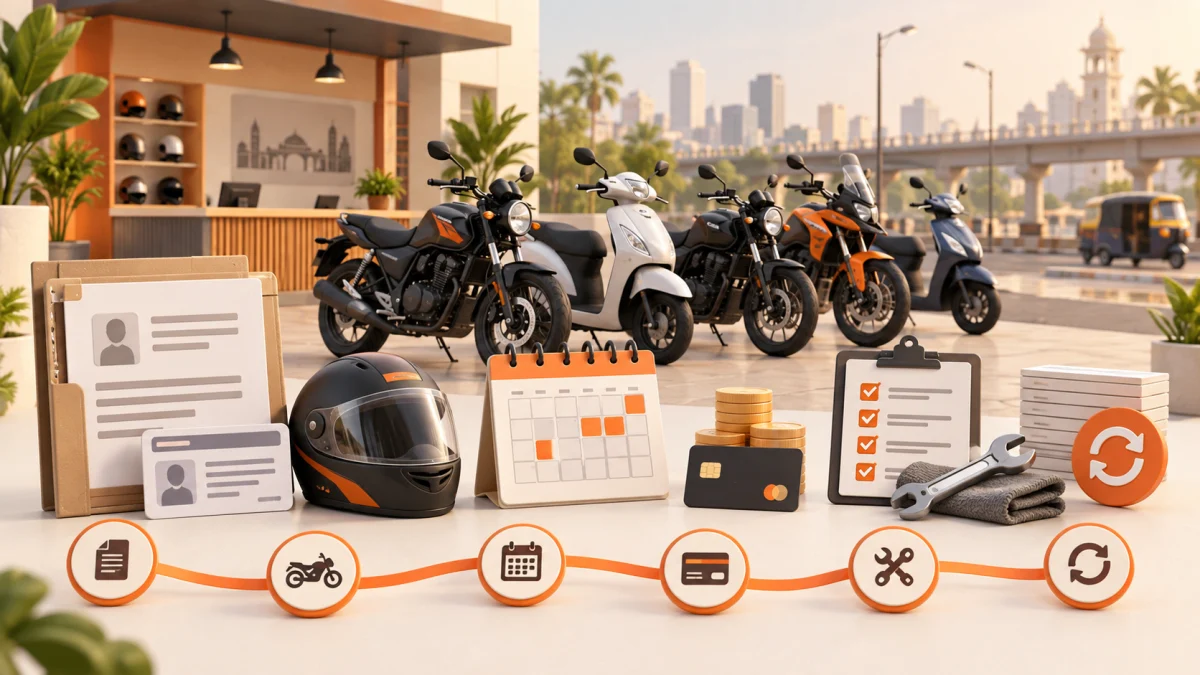
To start a bike rental business in India, validate state licensing first, then plan eligible vehicles, insurance, customer checks, agreements, deposits, maintenance and incident handling. Build booking software only after legal responsibilities, fleet economics and operating ownership are clearly documented.
Planning a project? Explore Crisant's bike rental portal software →
How to start a bike rental business in India legally
Begin with the transport authority, not the app. The central Rent a Motor Cycle Scheme, 1997 regulates the business of renting motorcycles to people who drive them for their own use. It says an operator cannot conduct that business without a licence granted through the State Transport Authority and defines an operator by reference to permits for at least five motorcycles. The applicable forms, vehicle eligibility, local process, taxes and operating conditions still need confirmation in the state where the business will run.
The 2021 amendment extended the scheme's application to specified battery-operated and methanol- or ethanol-driven motorcycles that are exempt from section 66 permit requirements. It did not remove the operator-licence requirement. Do not interpret an electric vehicle's permit exemption as permission to start renting without the correct operator approval.
Ask the jurisdictional transport office for a written checklist before buying the fleet. Have a transport-law professional confirm the proposed entity, premises, vehicle registration, permits, licence, display requirements, records and cross-border use. This article is a planning guide, not legal or tax advice; a bike rental licence India search result cannot replace the authority's current answer for the actual location.
Build the fleet economics before buying motorcycles
A two wheeler rental business is an asset-utilisation operation. Revenue depends on paid rental time, but cash leaves through finance, depreciation, insurance, permits, servicing, tyres, cleaning, parking, staff, payment fees, technology, damage recovery and idle days. Model each vehicle category separately because a commuter scooter and an adventure motorcycle can have different demand, service intervals and repair exposure.
Avoid publishing one universal startup-cost number. Purchase prices, deposits, commercial-use insurance, state fees, rent and finance terms vary. Collect written supplier, insurer and authority quotes, then calculate break-even using conservative booked days and downtime. Include a reserve for major repairs and replacement vehicles rather than treating every deposit as income.
| Planning line | Evidence to collect | Decision to make |
|---|---|---|
| Licensing and permits | Current authority checklist and fees | Launch location and eligible fleet |
| Vehicle acquisition | On-road quotes and finance terms | Buy, finance or phase purchases |
| Insurance | Written commercial-use confirmation | Cover, excess and claims process |
| Utilisation | Demand by day, season and vehicle class | Fleet mix and minimum viable size |
| Maintenance | Service, tyre and repair estimates | Downtime reserve and workshop plan |
| Technology | Booking and operating requirements | Configure, integrate or build |
Design customer, vehicle and incident controls
Write the operating policy before opening bookings. Define which identity and driving-licence checks are required, who may approve or reject a rider, how deposits are authorised and refunded, and what evidence records vehicle condition at handover and return. Collect only data the business is entitled to use, restrict staff access, define retention and deletion, and obtain specialist privacy advice for the chosen process.
Each motorcycle needs a current operational record: registration and permit status where applicable, insurance, service due dates, tyres, kilometres, damage notes, keys, accessories and availability. IRDAI states that third-party liability cover is mandatory for vehicles plying on public roads; the operator should obtain written confirmation that the policy and declared use are suitable for rentals rather than assuming an ordinary personal policy is enough.
Plan failures as carefully as clean bookings. Document late returns, roadside breakdowns, accidents, challans, missing documents, disputed damage, payment failure and emergency escalation. Specify who speaks to the rider, who can block the vehicle, what evidence is stored and when the insurer or authority must be contacted.
Choose bike rental software around the operating model
Bike rental software should prevent conflicting bookings and keep the reservation, rider record, payment, deposit, vehicle condition and document status connected. Start with the required states: available, held, booked, checked out, overdue, under inspection, under service and unavailable. Then define who can move a vehicle between states and what evidence is required.
Crisant's documented base product includes a booking website and rider app, digital KYC capture, UPI and card payments, deposit tracking, fleet and service records, document reminders, dynamic pricing and optional GPS integration. Those capabilities are a starting point, not a promise that every workflow or legal requirement is automatic. The implementation still needs the operator's approved policy, payment account, insurer inputs and local compliance decisions.
Integrate only what has a clear owner. A payment success must map to the correct booking; a deposit refund needs an approval and audit trail; a GPS alert needs a response rule; a service block must remove the vehicle from sale. Exportable booking, payment and fleet records are essential so the business can reconcile accounts and change providers without losing operational history.
Pilot one location before scaling the fleet
Run a controlled pilot with the minimum fleet permitted by the confirmed model and authority conditions. Test search, availability, pricing, payment, rider approval, handover, extension, return, refund and service blocking from beginning to end. Include intentionally failed scenarios: rejected licence, duplicate slot, payment timeout, late return and a motorcycle that becomes unavailable after booking.
Measure booked days, cancelled bookings, turnaround time, maintenance downtime, payment exceptions, deposit disputes and support workload by vehicle. These are operational indicators, not vanity metrics. A full calendar can still lose money if pricing ignores downtime or if staff spend hours reconciling WhatsApp, spreadsheets and payment screenshots.
Expand only when staff can follow the process without the founder resolving every exception. Add vehicles, categories or locations in phases; preserve one source of truth for availability and document ownership. New demand is useful only when the fleet remains safe, insured, serviceable and legally deployable.
Use a 30-day launch-readiness plan
In week one, verify the licence pathway, entity, premises, fleet eligibility and insurer position. In week two, model economics and write customer, vehicle, payment, privacy and incident policies. In week three, configure the booking and fleet workflow with representative motorcycles, rates and users. In week four, complete scenario testing, staff training, reconciliations and an authority or adviser review before accepting a public booking.
Udyam registration is free and paperless for eligible MSMEs, but it is not a substitute for the transport operator licence. GST registration and invoicing responsibilities depend on the actual entity, turnover and supplies; confirm them with a qualified tax adviser using current CBIC guidance. Keep approvals, policies and renewal ownership visible inside the launch checklist.
The safest first version is the smallest system that supports a verified operation. Request a free growth audit to map the proposed fleet, booking journey, payment controls and software responsibilities. The result may be a configured base product, a focused integration or a phased custom build after licensing and economics are clear.
Bring your proposed city, fleet mix, rental model and operating checklist to a focused fit assessment. We will map the booking, payment, vehicle, document and service responsibilities before deciding whether configuration, integration or custom development is appropriate.
Request a bike-rental workflow assessment →