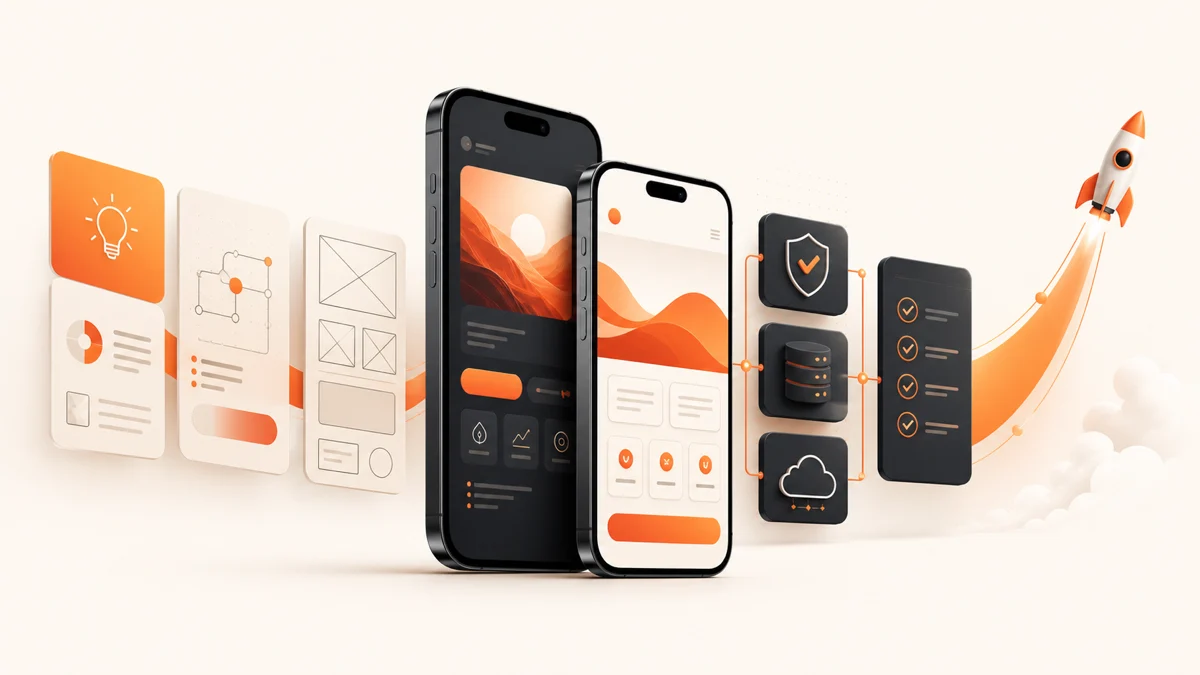
The mobile app development process turns an idea into a testable release through six gates: problem evidence, scoped journeys, prototype, architecture, production testing and store readiness. Each gate should produce proof before more budget is committed, then continue after launch.
Planning a project? Explore our mobile app development service →
The mobile app development process starts with evidence
An app idea is not yet a product brief. Begin by naming the person with the problem, the situation in which it appears and the business outcome that would justify a release. Interview likely users, observe the current workaround and record where time, accuracy or service quality breaks down. The aim is not to prove that the original idea is right; it is to find a problem important enough to solve.
Write one measurable product hypothesis. For example: a field team should be able to receive a job, capture proof and close it without returning to the office. That statement is more useful than a feature list because it connects the customer journey to an operating result. It also exposes whether a responsive web application, process change or existing tool could solve the problem before a mobile build is justified.
Agree the decision gate before discovery ends. Evidence may be repeated interview themes, a prototype task completed without explanation, a signed pilot commitment or a manual service that customers already use. Avoid fictional precision: early evidence reduces uncertainty, but it does not guarantee adoption. The output should be a short problem brief with target user, current alternative, intended outcome, major assumptions and a clear next decision.
Scope one complete journey for the first release
A useful first release completes one end-to-end job. Map the entry point, authentication, core action, confirmation, exception path and the staff work behind the screen. A customer booking app, for instance, also needs availability rules, notifications, cancellations and an operator view. Ignoring the administrative journey simply moves product complexity into phone calls and spreadsheets after launch.
Separate must-have behaviour from attractive inventory. A must-have is required for the chosen journey to work safely and honestly. A later item may improve convenience, reach a second audience or automate an edge case after the team has evidence. Record exclusions as carefully as inclusions so that design reviews do not quietly expand the budget.
Define acceptance in observable language. Replace ‘fast’, ‘secure’ and ‘easy’ with specific scenarios, supported devices, roles, data rules and recovery behaviour. State who owns source code, design files, cloud accounts, signing keys and store accounts. This makes the release boundary testable and prevents a technically complete app from arriving without the access needed to operate it.
Prototype the risky decisions before committing architecture
A clickable prototype should test navigation, language, hierarchy and the hardest user decisions before production code. Put it in front of representative users and ask them to complete realistic tasks without coaching. Watch where they hesitate, take the wrong branch or fail to recognise the next action. A polished presentation is less valuable than evidence that the journey can be understood.
Run a separate technical spike for the least ordinary capability: background location, offline synchronisation, Bluetooth, media processing, payments, regulated data or a specialist SDK. The prototype tests desirability and usability; the spike tests feasibility. Together they give a better basis for choosing native, Flutter, React Native or a web-first path than framework preference alone.
| Gate | Evidence to produce | Decision it supports |
|---|---|---|
| Problem | Observed workflow, user interviews and a written hypothesis | Whether the problem deserves investment |
| Journey | One complete flow with roles, exceptions and acceptance criteria | What belongs in the first release |
| Prototype | Task observations from representative users | Whether people understand the proposed experience |
| Technical spike | Working proof of the highest-risk integration on real devices | Architecture and platform choice |
| Release candidate | Production build, test record, store assets and operational runbook | Whether the product is ready for controlled launch |
Design architecture around operation, not only screens
The visible app is one part of the system. Most business products also need APIs, data storage, authentication, notifications, analytics, an administration interface and support tools. Draw how data moves between the phone, backend, third-party services and staff. Mark sensitive fields, ownership boundaries, failure modes and what should happen when connectivity disappears.
Use least privilege for user and staff roles, protect secrets outside the application package and plan how accounts, sessions and devices can be revoked. OWASP MASVS organises mobile controls across storage, cryptography, authentication, network communication, platform interaction, code quality, resilience and privacy. It is a practical reference for defining assurance work, not a badge that replaces threat modelling or testing.
Choose technology after these constraints are visible. Shared-code frameworks can reduce duplicated delivery for suitable products; native development can provide direct platform control for demanding device work. The decision record should state the chosen approach, rejected alternatives, dependency risks, production infrastructure and conditions that would trigger a review. Future maintainers need the reasoning, not just the repository.
Test the production release, not just development builds
Quality assurance should follow the agreed journeys and exceptions across realistic devices, accounts and networks. Cover interrupted actions, permission denial, expired sessions, duplicate taps, slow connections, upgrade paths, accessibility and recovery from backend failure. Automate stable high-value checks, but keep exploratory testing for behaviour that scripted cases will not anticipate.
Android’s official release guidance separates configuration, signing and production testing from ordinary debugging. It advises teams to disable debugging and logging, use production server paths, review permissions, sign the release and test the release version under realistic conditions. Treat those as build responsibilities from the start rather than a checklist discovered on launch day.
Apple recommends reading its App Review Guidelines while planning and building, using TestFlight to gather beta feedback and preparing product-page assets and privacy details before submission. Store review is an external dependency, so keep release dates honest and prepare reviewer access, notes and working backend services. A build uploaded to a console is not yet a reliable customer launch.
Launch in a controlled group and keep learning
Start with the smallest audience that can generate real operating evidence. Confirm onboarding, support ownership, crash reporting, analytics consent, backups, alerting and escalation before promotion expands. Track journey completion, qualified usage, support reasons and business outcomes rather than celebrating downloads alone. Early behaviour should decide which friction to remove and which requested features can wait.
Prepare a release runbook that names the decision maker, rollback path, store credentials, server owner, support channel and communication plan. Maintain a prioritised defect list and distinguish urgent safety or service failures from normal product learning. Controlled rollout protects customers while giving the team time to interpret signals without rewriting the roadmap after every comment.
Post-launch work includes operating-system updates, dependency reviews, security fixes, analytics checks, store compliance, performance monitoring and deliberate product improvements. Budget and ownership should cover these responsibilities before approval to build. Use our free growth audit to turn the open questions into a staged plan; the strongest launch plan is a repeatable system for releasing, observing, protecting and improving a useful product.
A useful app plan converts assumptions into evidence before the expensive work begins. Our free growth audit maps the user journey, release boundary, operating needs and highest-risk technical questions so your next decision has a defensible basis.
Turn your app idea into a practical launch plan →