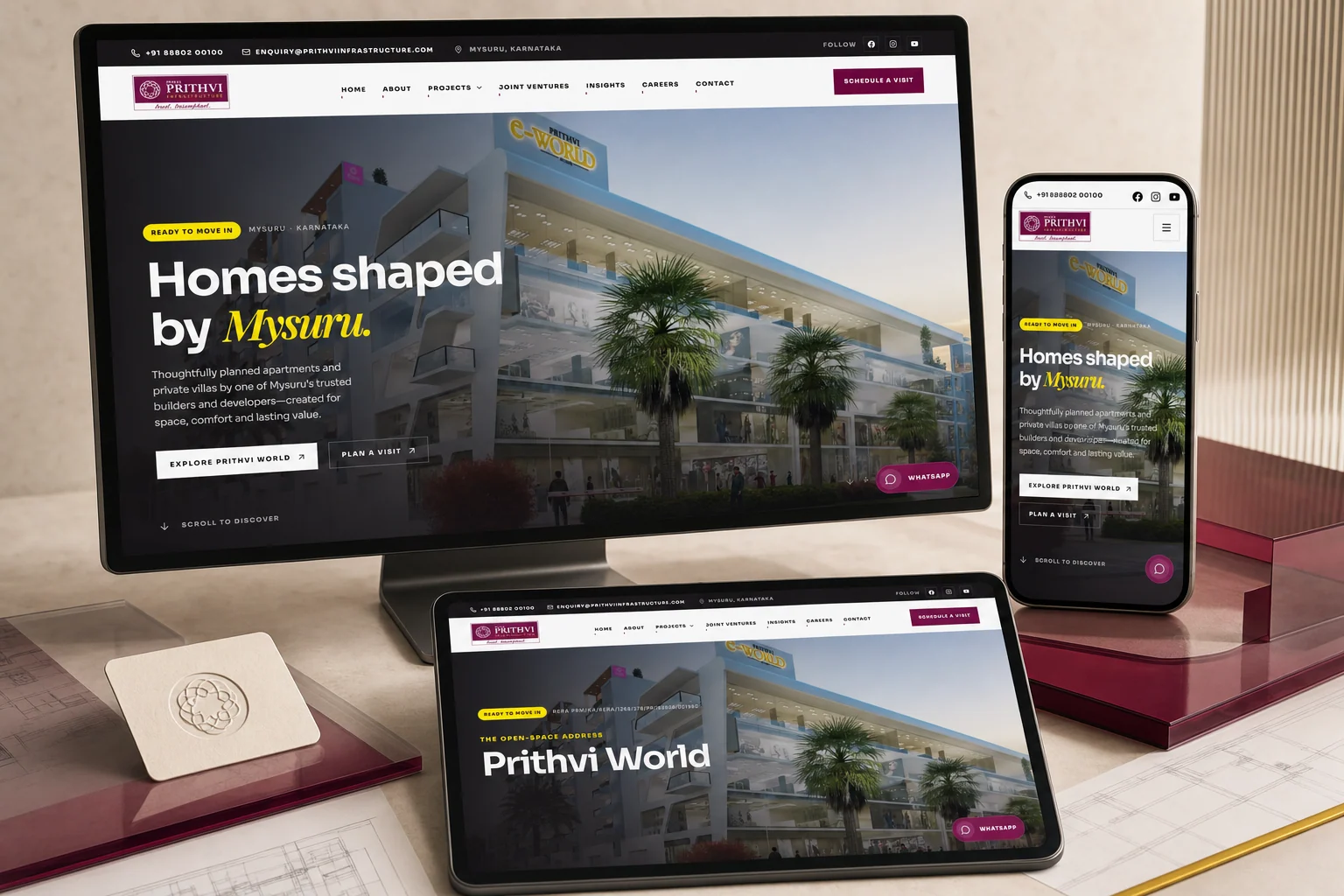
Real estate website design Mysore projects work best when they combine emotional positioning with practical buyer evidence. The Prithvi case study shows how clear project status, RERA details, responsive layouts and several enquiry routes can turn browsing into site-visit decisions.
Planning a project? Explore Crisant's website development service in Mysore →
Why this real estate website design Mysore project was needed
Prithvi Infrastructure had five named residential destinations to present: Prithvi World, Prithvi Orchids Villa, Prithvi Palace, Prithvi Lifestyle and Prithvi Castles. The website could not treat them as interchangeable cards. Each project needed its own status, proposition and decision detail while still feeling part of one developer portfolio. That meant the work began with information architecture and buyer questions, not with a visual theme.
A homebuyer evaluates emotion and evidence together. Photography, architecture and lifestyle create interest, but status, configuration, location, RERA information, amenities and the possibility of a site visit determine whether that interest can move forward. The need was therefore broader than a gallery-led builders website design Mysuru project: it was a confidence system for people comparing expensive, long-term choices on desktop and mobile.
How we structured the buyer journey before development
The experience was organised around a sequence a serious buyer can recognise. The opening establishes the Mysuru connection and the developer. Availability appears while visitors browse, allowing ready-to-move, active and completed work to be understood at the comparison point. Dedicated project routes then introduce development facts, configurations, highlights, walkthroughs, amenities, gallery, location, brochure and enquiry actions without forcing every visitor through the same generic landing page.
This structure also protects the portfolio from becoming a catalogue that grows harder to use with every new project. Shared modules provide consistency, while project-specific content carries the distinct selling context. For property website development India, that balance matters: reusable components reduce maintenance effort, but the content model must still leave room for legal details, local context, availability and the evidence unique to each address.
How the Prithvi visual system was imagined
The design direction started with Prithvi's existing seal and wordmark instead of applying a generic premium-property palette. Brand wine and deep wine create continuity; signal yellow draws attention to availability and actions; architectural pearl gives plans and long descriptions space to breathe; residential ink keeps important information readable. Playfair Display introduces an editorial sense of place, while Sora supports compact navigation, status labels and practical details.
The opening idea, ‘Homes shaped by Mysuru’, gives the Prithvi Infrastructure Mysore story a proposition the developer can own. It is more useful than an unsupported luxury claim because it connects design, location and local knowledge. Large architectural imagery creates desire, but it is consistently paired with status, project facts and the next useful action. The visualisation was judged by whether it clarified the choice, not by how dramatic a static presentation looked.
How the React and Next.js website was developed
Crisant developed the responsive experience as a React and Next.js system with shared page patterns for the developer story, portfolio discovery and detailed project evaluation. The production layouts were documented from a 1440px desktop view down to a 390px mobile viewport. Mobile was treated as its own reading path: status, location, configurations and visit actions remain legible and reachable without shrinking a desktop composition into a narrow column.
The React real estate website case study also demonstrates why component reuse should follow content logic. A status badge, fact grid, amenity group, gallery, brochure action and visit form can be reused, but their sequence changes according to buyer intent. Phone, WhatsApp, directions, brochure and structured visit requests provide several conversion routes because property research rarely moves through one preferred channel.
How the complete keyword set supports one canonical service
This article uses the language attached to the verified project rather than creating competing city pages. The Prithvi Infrastructure website and the full case study supply the proof. Phrases such as real estate website design Mysore, builders website design Mysuru and Next.js website development Mysore describe the delivered work, while property website development India and React real estate website case study capture broader research intent.
Those phrases support, rather than replace, Crisant's canonical website-development page. The commercial intent remains owned by one service URL; this article answers the narrower question of how a property website can be planned and visualised. That separation helps readers reach real evidence without forcing the case study page, blog article and service page to compete for exactly the same role.
What the finished Prithvi website demonstrates
The finished system connects five residential addresses inside one recognisable digital portfolio. It creates a clearer path from the first impression to status, configurations, project facts, gallery, location and private visit. The result is qualitative evidence of the delivered architecture and responsive system; no enquiry, sales or revenue improvement is claimed without client-supplied analytics.
Visit the live project link above and examine the order of information on both desktop and mobile. The useful lesson is not to copy its colours or layout. It is to define the evidence a buyer needs, visualise that evidence with an ownable brand system, and develop reusable components around the real decision journey. A free growth audit can identify where an existing property website breaks that sequence.
A property website should help a serious buyer move from interest to evidence and then to a visit. Crisant can review your project architecture, responsive journey, content gaps and enquiry routes before you invest in a rebuild.
Request a property website review →