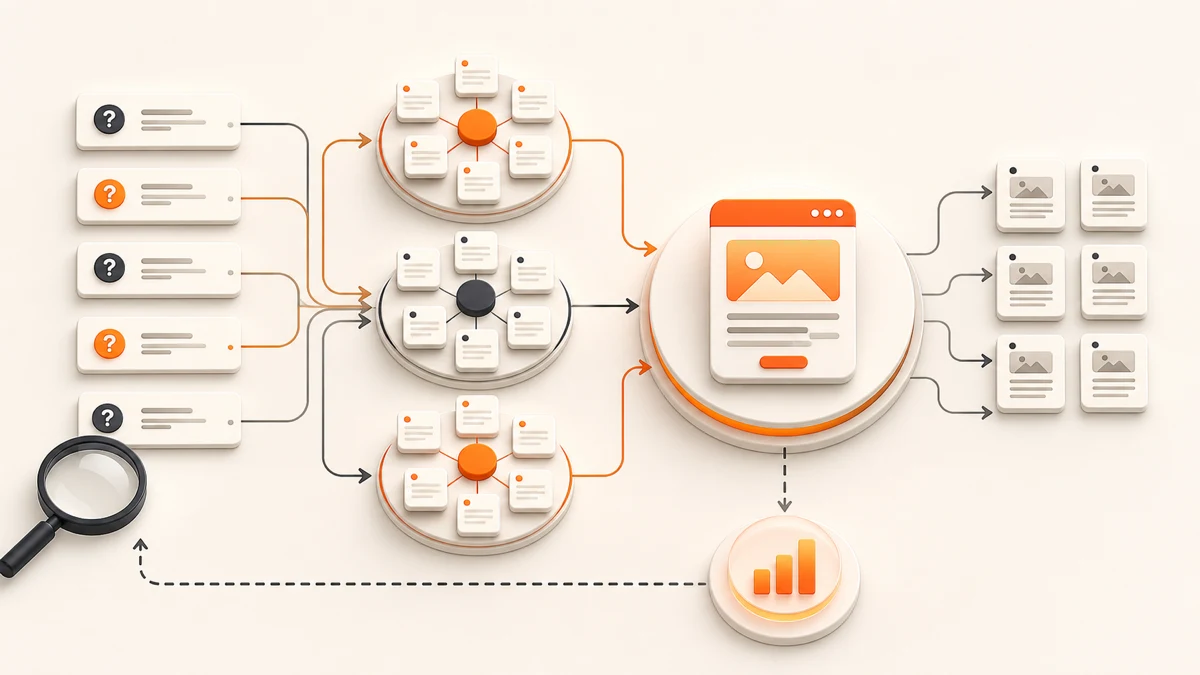
SEO content strategy Mysore businesses can use starts by mapping customer questions to search intent, assigning one authoritative page to each topic, connecting supporting articles through useful internal links, and reviewing performance so the content library grows without competing pages.
Planning a project? Explore Crisant's SEO and digital marketing work in Mysore →
Start SEO content strategy Mysore with customer questions
A useful strategy starts before keyword tools. Collect the questions people ask during enquiries, sales calls, support conversations and project reviews. Add the terms already visible in Search Console, the language used on competitor pages and the decisions a buyer must make before contacting a provider. This search intent mapping produces a demand map rooted in the business rather than a list of attractive search volumes.
Separate questions by the job they perform. Some indicate a buyer looking for a service, location or provider. Others show a need to compare options, understand cost, solve a problem or prepare for implementation. The same word can carry different intent in different phrases, so read the whole question. A person searching for a content creation agency in Mysore needs a service destination; someone asking how to plan internal links needs an educational answer.
Google recommends people-first content that helps an intended audience achieve a goal. That means a topic belongs in the plan when Crisant or the client has relevant expertise, a real audience need and something useful to add. Publishing only because a phrase appears popular creates a scattered library and weakens the reason a reader should trust the site.
Assign one authoritative page to each search intent
Turn the demand map into a page map. Give each distinct intent one primary destination and record its purpose, audience, target query family, evidence and next action. A service page should explain the offer, suitability, proof, process and route to an enquiry. A guide should answer a narrower research question without pretending to be another service page. A case study should document verified work rather than repeat a generic sales promise.
This assignment prevents content cannibalisation before it begins. Two pages do not compete merely because they share a word; the problem arises when they try to satisfy the same person, question and next step without a clear reason for both to exist. When overlap is high, improve the stronger destination, consolidate useful material and redirect the retired URL instead of adding another near-duplicate article.
Local wording also needs discipline. Mysore and Mysuru are two names for the same city, not automatic justification for duplicate pages. Use both naturally on one canonical destination unless the business has genuinely different locations, services or evidence. A stable page owner lets titles, internal links, updates and external promotion reinforce one place over time.
Build SEO topic clusters and internal links around decisions
A topic cluster is useful when its pages help a reader move through related decisions. Begin with an authoritative service or solution page, then add supporting guides only for questions that deserve their own complete answer. A cost guide can support budgeting, a comparison can support platform choice and a case study can supply proof. Each page needs a distinct promise while remaining visibly connected to the wider subject.
An internal linking strategy should explain the relationship. Use concise anchor text that tells the reader what the destination contains. Link a supporting guide upward to the relevant service, sideways to the next useful question and, where appropriate, from the service page back to high-value evidence. Google notes that a logical site structure and relevant internal-link text can help people and search systems understand important pages.
| Content role | Primary visitor question | Useful destination |
|---|---|---|
| Service page | Can this team solve my problem? | Offer, fit, process, proof and enquiry path |
| Cost guide | What should I budget and why? | Ranges, cost drivers, inclusions and next step |
| Comparison | Which option fits my situation? | Decision criteria, trade-offs and recommendation |
| Case study | Has this team handled similar work? | Need, approach, delivered work and verified evidence |
| Checklist | What should I prepare or review? | Ordered actions, ownership and failure checks |
Write briefs that protect originality and business relevance
A content brief should guide judgment rather than prescribe a pile of keywords. State the audience, current situation, question, intended outcome, primary page role, evidence available and the action that follows. List sources that must be checked, claims that require approval and examples the business can support. Include the related service page and two genuinely useful internal destinations before writing begins.
The writer should then add value beyond summarising public sources. That may come from a decision framework, a tested process, a useful table, local context, original examples or a clear explanation of trade-offs. Google asks whether content provides original information or analysis and whether a reader leaves feeling they learned enough to achieve a goal. Those are stronger review questions than whether a draft repeats an exact phrase a fixed number of times.
Use AI carefully. It can assist with research organisation, transcription or alternative outlines, but somebody must remain accountable for the angle, writing, source verification and final accuracy. Remove invented examples, generic claims and language that could belong to any company. The finished page should show why this business is qualified to answer the question and what the reader can do with the answer.
Measure pages by query, role and qualified action
Measurement begins with the role assigned in the page map. A research guide may earn relevant impressions, clicks and progression to a service page. A service page may be judged by qualified enquiries, calls or another defined commercial action. A case study may assist evaluation without being the first landing page. Avoid forcing every URL into the same conversion expectation.
Review Search Console queries and their receiving URLs together. If several pages appear for the same query family, inspect whether they serve different intents or reveal accidental competition. If one page receives impressions for a useful question but few clicks, assess the title, description and fit with the query. If visitors arrive but do not continue, inspect whether the answer, structure, evidence and internal next step are clear.
Combine search evidence with analytics and enquiry notes. Rankings alone do not show whether the right people understood the business. Record which pages support qualified conversations, which questions recur in sales and which articles create no defensible next step. This makes the next editorial decision about improvement, consolidation or removal rather than simply adding volume.
Run a 90-day content marketing Mysore workflow
Start the first month with an inventory. Export current URLs, group them by intent, mark the authoritative destination for each subject and identify duplicate or unsupported pages. Add customer questions, Search Console evidence, service priorities and available proof. Choose a small set of changes that improve the existing library before approving new production.
In the second month, update high-value destinations and create only the missing support pages with clear briefs. Add internal links as each page is published, verify titles, metadata, canonicals, schema and mobile readability, then request indexing through the supported Search Console flow. Keep an editorial record so another person can see why each URL exists and which page owns the topic.
Use the third month to review what changed. Compare query-to-page alignment, qualified actions, recurring sales questions and pages that remain isolated. Continue the subjects with repeated evidence, improve promising pages and consolidate material that still competes. For an independent map of search intent, page ownership and internal links, request a free growth audit before filling the next calendar.
Bring your service list, current URLs, Search Console exports and the customer questions your team hears most often. Crisant can map content roles, competing pages and internal-link gaps before recommending what to create, consolidate or improve.
Request a free content and SEO review →