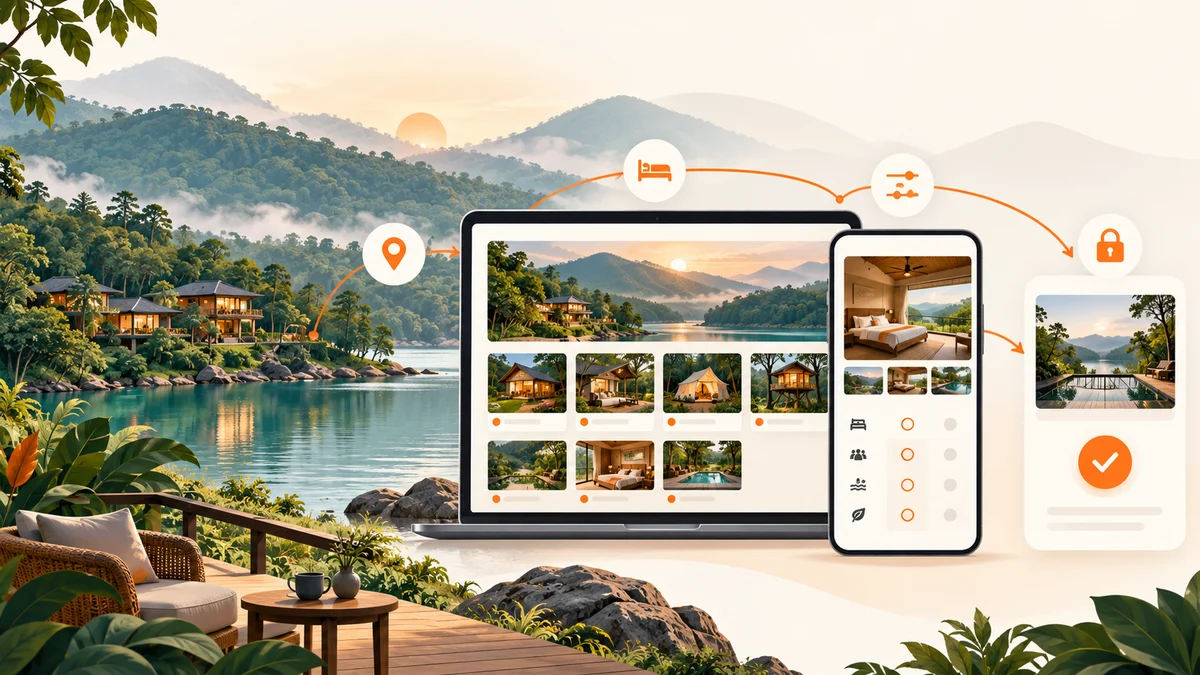
Resort website design should turn atmosphere into a verifiable guest decision. Waterview Holiday Retreat shows how responsive storytelling, authentic photography, six compared stays, factual amenity content and a secure booking handoff can support discovery without inventing availability or performance results.
Planning a project? Explore Crisant’s website development service in Mysore →
Why this resort website design project was needed
Waterview Holiday Retreat serves couples, families and organised groups from a nature-led property in Bolenahalli, Sakleshpur. Its offer spans six different stay categories, shared recreation, meals and waterside surroundings. A useful website therefore needed to do more than create a scenic first impression. It had to help visitors understand whether the rooms, beds, amenities, location and booking route matched the people travelling.
That creates a familiar hospitality design tension. Too much atmosphere can hide the practical facts required before payment. Too much inventory can make a distinctive retreat feel like a commodity. The Waterview Holiday Retreat Sakleshpur brief was to hold both jobs in one sequence: establish the feeling of the place, then make the stay choices progressively easier to inspect without promising availability, inclusions or performance that the website could not verify.
The project also needed one accountable source for the published offer. The live site now identifies Couple Room, Premium Room, Suite, Quadrable Deluxe, Dormitory Deluxe Rooms and Tent Stay, while asking guests to confirm final capacity, rates, taxes, meal inclusions and date-specific conditions. That factual boundary became part of the experience rather than an afterthought hidden near payment.
How we planned the guest decision journey
The information architecture follows the questions a guest is likely to ask. First, where is the retreat and what does it feel like? Next, which stay fits the people travelling? Then, what can the group do together, what is included, what should be confirmed and where is live availability checked? This journey shaped the homepage, Rooms, Amenities, Experiences, Gallery, About and Contact routes before individual screen layouts were composed.
The room system turns six stay names into comparable decisions. Each option combines authentic imagery, a distinct proposition, published bed information, careful occupancy language, listed comforts and a guide price. Every card leads to a focused room route, so a visitor can compare quickly and then examine the relevant stay without carrying the entire catalogue through one long page.
Discovery and transaction were deliberately separated. The Waterview Holiday Retreat website owns the resort story, room comparison, operating context and direct contact choices. The official secure booking provider owns date-specific availability and payment. Keeping that handoff visible gives the guest a clear route while avoiding a decorative form that appears to confirm inventory it does not control.
How the Sakleshpur experience was visualised
The visual system begins with the property rather than a generic luxury-resort template. Forest green creates depth, lake blue connects the interface to water and the existing mark, leaf green supports landscape detail, quiet gold highlights useful actions and warm linen keeps longer explanations readable. Playfair Display gives destination language an editorial rhythm, while Inter keeps navigation, room facts and booking details direct.
Authentic property photography does most of the persuasive work. The wooded pool, real rooms, open spaces and waterside views show the experience guests will actually evaluate. Generous image fields create immersion on larger screens, but the visual sequence always returns to a practical choice: compare rooms, review amenities, check a condition, call the resort or open secure booking.
This approach is central to resort website design India projects where a guest may research on a phone with limited context. The design should create desire without manufacturing certainty. Strong atmosphere can coexist with qualifiers, guide-price language and visible confirmation steps. The identity becomes more credible when the interface is honest about what changes by date or room category.
How the responsive React resort website was developed
Crisant developed the experience as a React resort website on Next.js, using reusable content patterns for accommodation, amenities, experiences, dining, gallery and contact. The component system keeps repeated facts consistent while allowing every room route to carry its own images, bed layout, comforts and decision notes. This is where structured content and front-end engineering reinforce the guest journey rather than merely reproducing a visual mock-up.
The responsive design was documented from a 1440-pixel desktop viewport to a 390-pixel mobile viewport. On a wide screen, editorial scale and landscape imagery slow the pace. On mobile, the same Next.js hospitality website becomes a direct one-handed journey: cards stack cleanly, comparison facts remain readable, the menu stays compact and call or booking actions remain close without causing horizontal overflow.
This method also reflects practical hotel website development Mysore work. The production team has to account for content ownership, image delivery, responsive performance, contact paths and third-party booking systems together. A polished homepage is not enough if room data becomes difficult to update or the booking handoff disappears on the device most guests use.
What the hospitality decision framework controls
The framework below shows how the business need moved into a design and development control. It is not a claim about bookings or revenue. It documents the decisions visible in the delivered responsive resort website design and the evidence a prospective client can inspect on the live project.
| Guest need | Design response | Development control | Verification |
|---|---|---|---|
| Feel the destination | Real water, forest and property imagery | Responsive editorial image fields | Compare the interface with the live property photography |
| Choose a suitable stay | Six distinct accommodation cards | Shared data structure with room-specific routes | Review bed, occupancy, amenity and guide-price language |
| Understand shared experiences | Separate amenity, dining and experience chapters | Focused routes with reusable navigation | Confirm operating details with the resort |
| Check current availability | Visible booking and contact actions | Secure external booking-engine handoff | Use the official provider for dates and payment |
| Research on mobile | Compact hierarchy and persistent actions | 390-pixel production layout without horizontal overflow | Inspect the live site on a narrow viewport |
What the completed hospitality website demonstrates
The delivered hospitality website case study connects one place story, six named stays and seven shared amenity themes inside a consistent responsive system. The outcome is qualitative: a clearer route from landscape and accommodation discovery to room evidence, operating context and secure availability checking. No occupancy, conversion, revenue or guest-satisfaction improvement is claimed without client-supplied analytics.
The live project links above provide the useful proof. Open the site on desktop and mobile, compare the room cards, follow an accommodation route and observe where the official booking engine becomes authoritative. The transferable lesson is not the palette or the page order. It is the discipline of matching every atmospheric choice with the next fact a guest needs.
A resort, homestay or boutique hotel planning a rebuild should begin by inventorying stay types, images, policies, inclusions, changing conditions, contact routes and booking ownership. That evidence gives designers and developers a safer brief than asking for a beautiful hotel website. A free growth audit can map the highest-impact gaps before the first visual direction is approved.
A useful resort website review begins with the real guest questions, the accommodation evidence available today and the booking system that must remain authoritative. Crisant can map those decisions before visual design or development begins.
Request a hospitality website review →