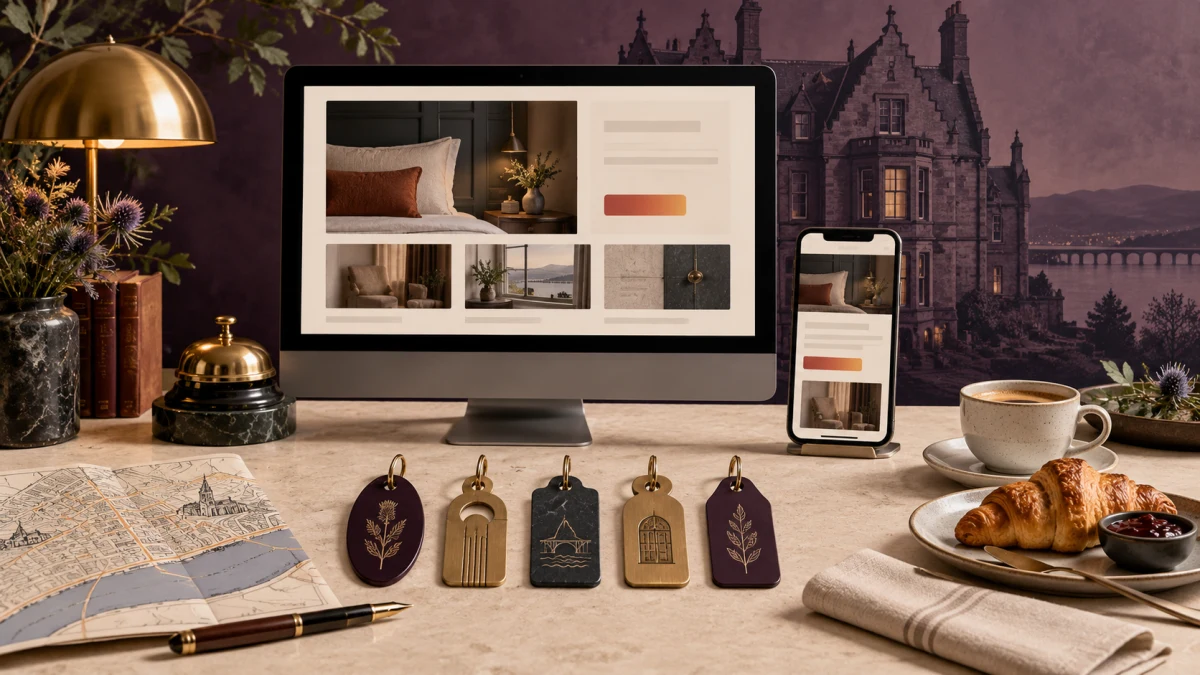
Hotel website design should help guests feel the property’s character, compare room choices, confirm practical inclusions and reach direct availability without friction. The Shaftesbury Hotel shows how responsive structure, local discovery and a distinctive visual system support that decision online.
Planning a project? Explore Crisant’s website development service in Mysore →
Why this hotel website design was needed
A hotel website has two jobs that can easily compete. It must create enough feeling for a guest to imagine the stay, while answering practical questions quickly enough to support a booking decision. The Shaftesbury Hotel needed both: a digital expression of a characterful 19th-century granite mansion in Dundee’s West End and a clear route through rooms, inclusions, location and availability.
The live hotel website presents an independently hosted property run by Juveria and Misbah. It describes five en-suite room types, breakfast served daily, Wi-Fi in public areas, nearby parking and a quiet West End address close to the city, universities, hospital and wider Tayside attractions. These details are useful only when guests can connect atmosphere to a room choice and the next practical step.
The project therefore required more than a decorative hospitality template. Crisant’s website development team had to organise the house story, room options, local discovery and direct availability as one stay-planning journey. This Shaftesbury Hotel Dundee website account documents visible design and development choices. It does not claim increased occupancy, direct bookings, revenue or conversion because comparative analytics were not supplied.
How the guest decision journey was structured
The opening proposition, ‘A grand old house, warmly yours,’ establishes the property’s character and the independent welcome in one line. Availability and room exploration appear immediately beside that emotional frame. The page then introduces the house, presents room choices, confirms everyday amenities, expands into Dundee discovery and returns to availability when the guest has enough context to act.
Five dedicated room routes—single, double, twin, triple and large double en-suite—share one comparison grammar. Each route can retain its own photography and detail while using consistent names, occupancy cues and actions. This avoids the common problem in boutique hotel website design where visual variety becomes structural inconsistency and guests must relearn the page for every room.
Location is treated as part of the stay rather than a footer address. The live experience connects the hotel with the University of Dundee, Ninewells Hospital, Dundee Airport and the waterfront, then extends trip planning to V&A Dundee, St Andrews, Arbroath Cliffs and Glamis Castle. Direct availability, phone, email and contact options remain visible without turning every editorial section into a sales interruption.
How The Shaftesbury Hotel website was visualised
The visual system is derived from the house rather than from generic luxury signals. Estate plum and house ink provide depth; antique gold marks focus and booking moments; quiet ivory creates warm reading surfaces; and Dundee stone connects panels and dividers with the mansion’s architectural material. The palette supports heritage without relying on exaggerated five-star symbolism.
A Baskerville-led serif voice gives headlines an editorial, lived-in character, while a restrained system sans-serif carries navigation, amenities and availability details with contemporary clarity. The combination lets atmospheric statements and practical information coexist. The typography changes role deliberately instead of using script or decorative type everywhere for a vague sense of luxury.
Real photographs of the exterior, rooms and breakfast setting provide the strongest proof. Desktop uses the mansion as a broad visual stage, while room cards and included amenities establish a repeatable information rhythm. On smaller screens, those elements become a guided vertical arrival. The identity remains recognisably Shaftesbury without asking visual decoration to substitute for useful hotel information.
How React and Next.js protected the booking path
Crisant developed a responsive React hospitality website with Next.js structures for the hotel story, room index, individual room pages, gallery, Dundee guide and contact journey. Reusable components keep room facts, amenity cues and availability actions consistent, while each route still answers a different guest question. That balance makes the system easier to maintain than five isolated page designs.
At a 1440-pixel desktop viewport, the interface can layer architectural photography, serif display copy, room choices and booking signals without crowding. At a 390-pixel mobile viewport, the same content becomes one calm sequence with comfortable touch targets and no horizontal overflow. The phone experience does not remove evidence merely to look shorter.
This Next.js hotel website development approach starts with priority before breakpoints. A responsive layout cannot rescue an unclear booking journey. Here the order stays stable across screens: understand the house, recognise the location, compare a room, confirm what is included, explore nearby reasons for the stay and reach direct availability or a human contact option.
What the direct booking website design controls
The framework below connects a guest question to an observable design response and a development control. Each point can be inspected on the live website or Crisant’s production case study. The table describes the delivered interface without presenting booking performance that would require private analytics.
| Guest question | Design response | Development control | How to verify |
|---|---|---|---|
| What kind of stay is this? | The house and West End setting lead | Responsive hero and story components | Review the homepage opening |
| Which room fits? | Five room types share one comparison grammar | Reusable room cards and dedicated routes | Compare the room index and detail pages |
| What is included? | Breakfast, Wi-Fi and parking appear early | Consistent amenity modules | Inspect homepage and room information |
| What can I do nearby? | Dundee and regional destinations support planning | Dedicated local-discovery route | Open Explore Dundee |
| How do I check availability? | Direct and assisted contact paths remain visible | Consistent booking, phone and contact actions | Follow an availability action without submitting |
What the completed hotel website demonstrates
The completed experience connects architectural character, five room choices, included breakfast, practical amenities, Dundee discovery and direct availability in one responsive system. Its evidence is inspectable: the house is visible, rooms are individually presented, inclusions are stated, local context has its own route and guests can move to availability or contact without searching a generic footer.
Open the live Shaftesbury Hotel website and compare the desktop and mobile paths. Notice how the house creates interest before the room system introduces choice, how amenities reduce uncertainty, and how the local guide expands the value of the location. Then review Crisant’s case study for the content architecture, colour system and documented production views behind those decisions.
The broader lesson in a hotel website development case study is that inspiration and information should support the same decision. Publish only the room, amenity and location facts the property can substantiate; give every room a consistent comparison structure; and keep availability visible without overwhelming the story. A free growth audit can identify where an existing hotel website breaks that sequence.
A useful hotel website review starts with the real stay decision: property character, room comparison, practical inclusions, local context and an uncomplicated availability route. Crisant can map that journey before visual design or development begins.
Request a hotel website review →